
How do we measure the success of this leadership development? What metrics will actually move?
Table of Contents
The Financial Architecture of Leadership: Translating Management into Margin
In the automotive industry, “leadership training” is often met with eye-rolls from Dealer Principals and GMs. And for good reason. Most management seminars focus on abstract concepts that evaporate the moment the wheels hit the showroom floor or the service drive gets backed up.
But true management capability isn’t an intangible “soft skill.” It is a structural lever that dictates the velocity of your inventory, the efficiency of your technicians, and the preservation of your gross profit.
When you upgrade your desk managers, F&I directors, and service managers from controllers to leaders, you fundamentally change the math of your dealership. Here is the deep-dive financial breakdown of the three operational buckets that move.
1. Retention & Turnover: Stopping the $25,000 Volume Bleed
The National Automobile Dealers Association (NADA) consistently tracks industry turnover, and the numbers are staggering: sales department turnover regularly hovers around 40% to 50%.
When a salesperson or advisor walks out the door, they don’t just take their desk nameplate; they take a massive chunk of your operational budget. The real cost of losing a single productive staff member includes:
-
Direct Sourcing Costs: Recruitment marketing, background checks, and drug screens.
-
The Onboarding Drag: The 30-to-60-day period where a new hire draws a guarantee or base salary while producing minimal gross.
-
The Trust Tax: Orphaned customers from the departed employee’s CRM portfolio who get lost in transition and buy their next car from a competitor.
-
The Lost Opportunity Cost: The 5 to 10 deals not closed during the vacancy and retraining period.
The Leadership Fix: People don’t quit dealerships; they quit managers. When your managers know how to coach rather than dictate, handle conflict transparently, and build clear career paths, your turnover drops. If a 10-store group reduces turnover by just one person per rooftop annually, that directly injects up to $250,000 back into bottom-line net profit.
2. Process Consistency: Raising the Performance Floor
In an undisciplined dealership, the revenue distribution curve looks like a mountain peak: two or three “superstars” carry the entire store, a mediocre middle gets by, and a rotating door of low performers drags down your averages.
Weak managers focus all their energy on riding the bottom performers or coddling the top performers. Strong leaders manage the process, which automatically elevates the median.
When your leadership team enforces process consistency across shifts, you will see a direct tightening of your key metrics:
-
The Showroom Floor: Closing percentages normalize. Instead of your store averaging 18% because your top guy closes 35% and your bottom team closes 8%, a trained manager desks deals actively to bring the floor up to a predictable 22%+.
-
The BDC: Internet and phone ups stop slipping through the cracks. Leadership ensures that BDC-to-appointment show rates are managed daily through real-time CRM auditing, not a retroactive review at the end of the month.
-
The Service Drive: Instead of advisors acting as passive order-takers, strong service managers coach their teams to execute a flawless multi-point inspection (MPI) presentation on every vehicle. This systematically drives up your average hours per repair order (CP-FRH).
3. Factory CSI & GX: Securing Your Turn-and-Earn Allocation
Your relationship with the manufacturer (OEM) is dictated by numbers, and few numbers carry more weight than your Customer Satisfaction Index (CSI) or Guest Experience (GX) scores.
Many dealers view CSI as a necessary evil or a vanity metric. In reality, it is a critical financial gateway.
-
The Allocation Engine: High CSI scores frequently influence turn-and-earn algorithms. If your regional ranking drops, your allocation of highly-coveted, high-margin inventory (e.g., top-tier SUVs, trucks, or high-demand EVs) can shrink.
-
The Cash Bonuses: For many brands, hitting specific CSI tranches unlocks significant stair-step money, back-end volume bonuses, or co-op advertising dollars. Missing your mark by a fraction of a point can literally cost a large store six figures in a single quarter.
The Leadership Connection: You cannot threaten or incentivize your way to sustainable high CSI. CSI is a trailing indicator of a healthy internal culture. When employees are well-managed, clear on their expectations, and not operating in a state of chaotic stress, they treat the customer like a guest. Exceptional customer service is simply the overflow of an exceptionally run team.
The Verdict: Leadership is a Variable Expense with a Fixed Return
Investing in your management team isn’t about giving them a motivational pep talk. It is about equipping them with the tactical communication, accountability, and operational skills required to protect your investment. When you look at your financial statement next quarter, you shouldn’t see an expense line for training—you should see a contraction in your employee acquisition costs and an expansion in your gross profit per unit.
Effective leadership isn’t a luxury; it’s a financial strategy. We don’t train managers to make them popular, we train them to run a tighter, more predictable, and significantly more profitable operation.
Schedule Leadership Development
Schedule Discovery CallLearn More About Leadership Development
Frequently Asked Questions
Find out more about how Modern Automotive Solutions can help you with Leadership Development
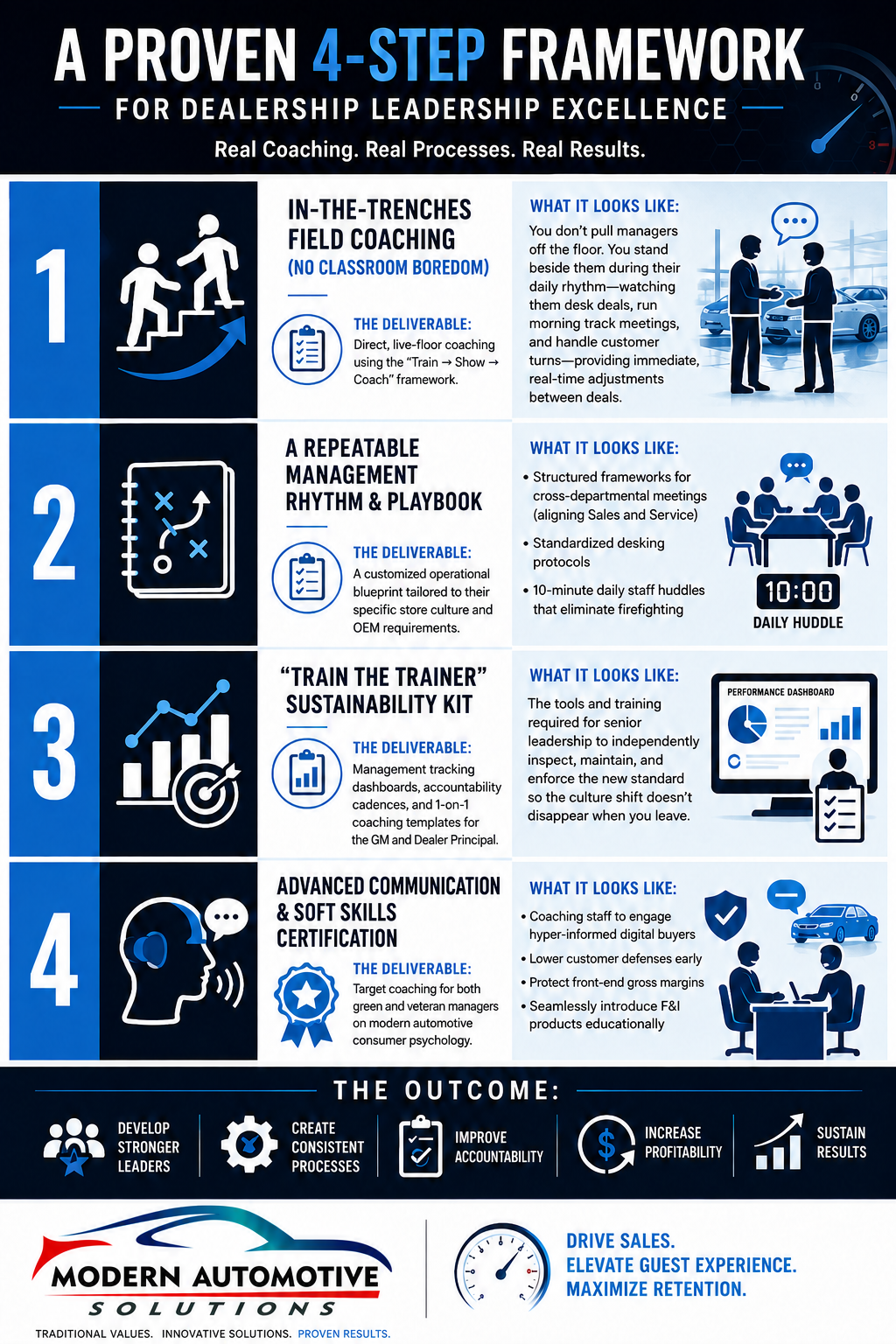
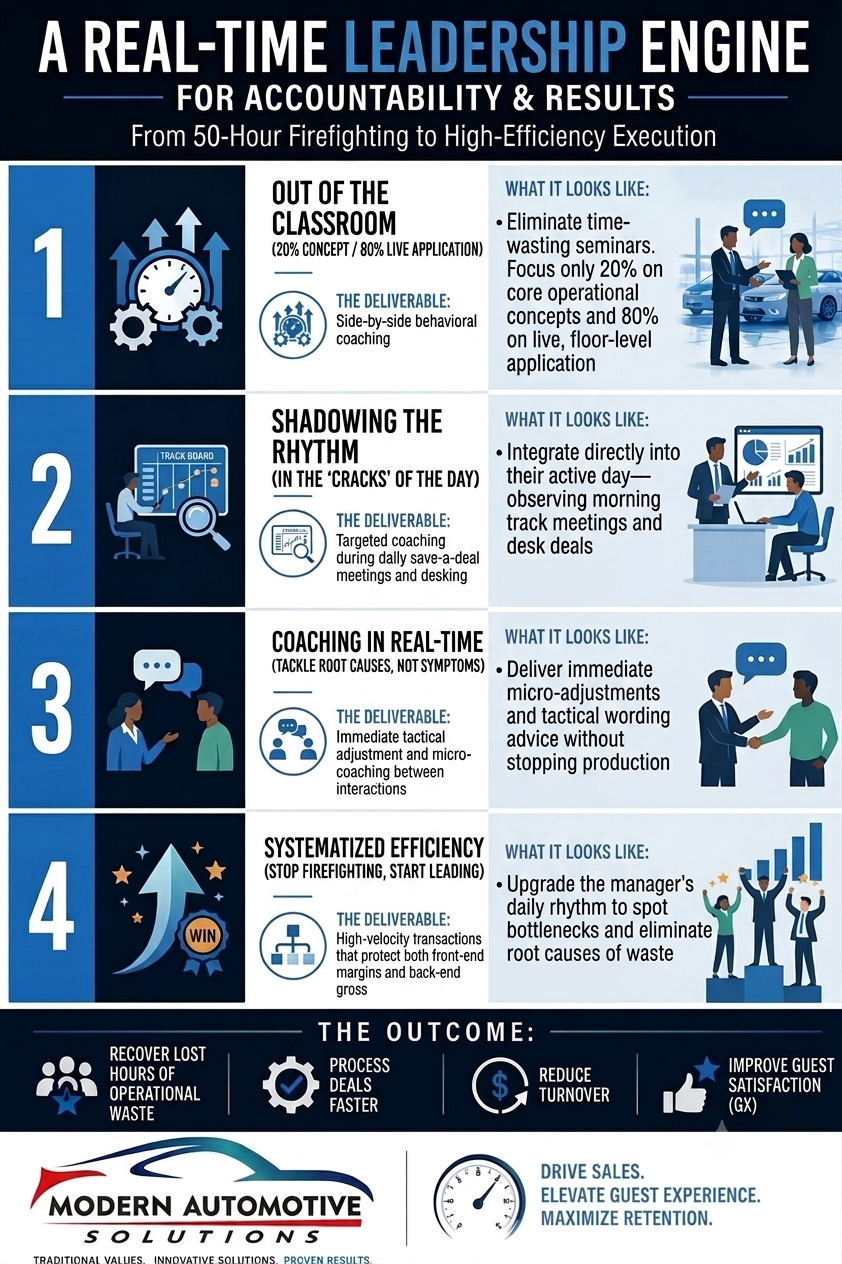
Our ‘Train → Show → Coach’ model means we spend about 20% of the time on the core concepts, and the other 80% is done live in the trenches. We shadow your managers during their actual day watching how they conduct the morning save-a-deal meeting, how they desk a deal, and how they handle a customer turn. We coach them in the cracks between deals and during real-time scenarios. We don’t take them away from the business; we help them manage the business they are already doing more efficiently so they stop having to fight fires all day.
We love those managers because they usually care the most about winning. The reason they resist outside trainers is because they’ve been burned by ‘theorists’ who couldn’t close a screen door, let alone a car deal.
We don’t walk in telling them they’re doing it wrong. We build trust by proving our own street cred first. We get on the live phones, we jump in on deals, and we speak their language. When we approach them, we frame leadership development as leverage. We show them how modern coaching methods will actually help them get more gross out of their green peas and reduce their personal stress so they don’t have to work 14-hour days to hit their numbers.
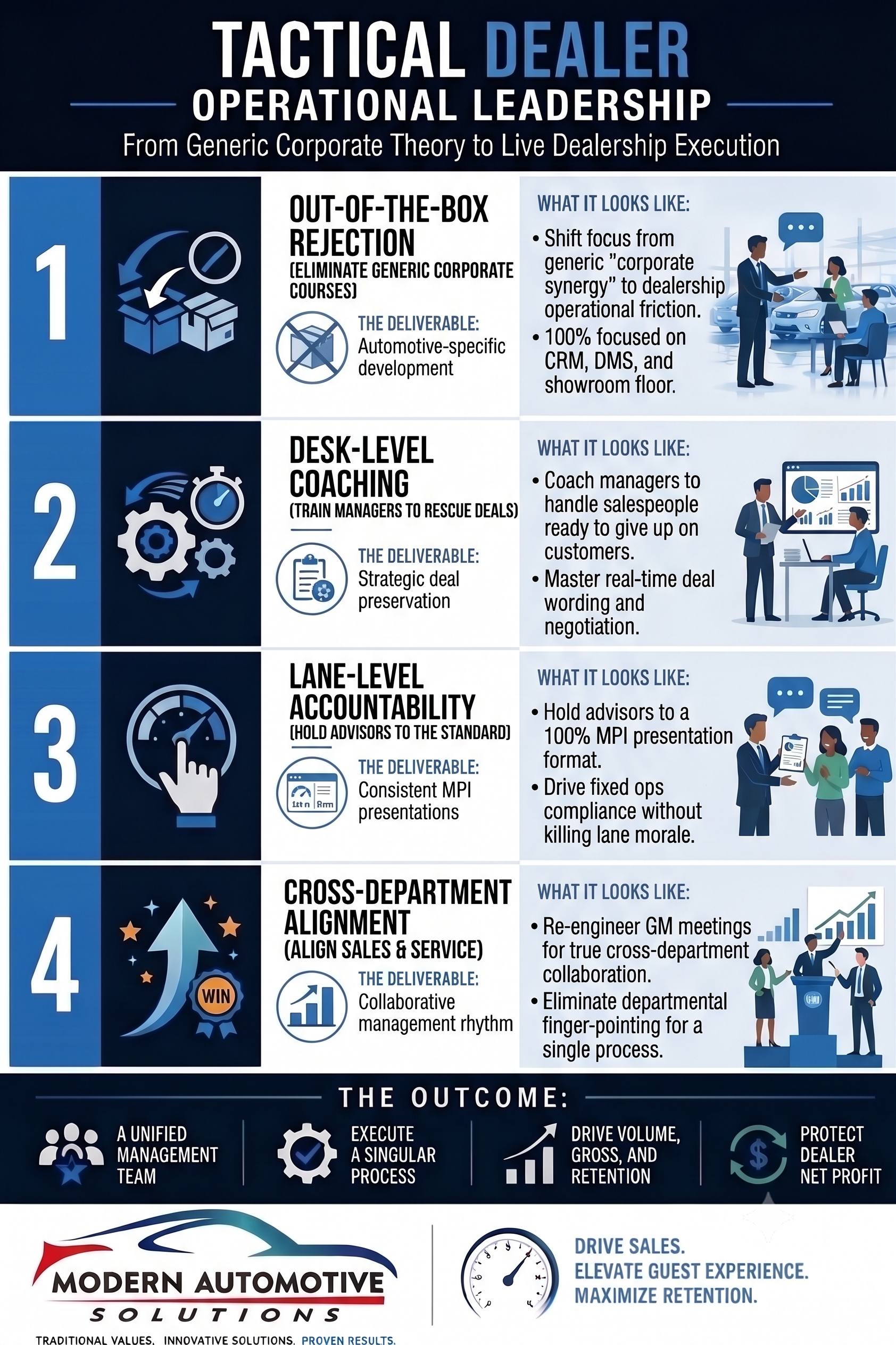
If this were a generic corporate course, your team would tune us out in five minutes. We don’t talk about ‘corporate synergy’ or abstract theories. Every single piece of our development is hyper-focused on dealership operations.
We coach specifically on things like: how a Desk Manager handles a salesperson who is ready to give up on a customer, how a Service Manager keeps advisors accountable to a 100% multi-point inspection presentation without killing morale, and how a GM runs a cross departmental meeting so that Sales and Service actually work together instead of pointing fingers. We live in the CRM, the DMS, and the service drive and not in a textbook.
he biggest flaw in the training industry is the ‘flavor of the month’ effect. We design our program from day one to ensure you don’t become dependent on us.
A massive part of our engagement is actually training you the GM or Dealer Principal how to coach the coaches. We don’t just teach your managers new habits; we give you the exact daily tracking mechanisms, weekly meeting frameworks, and accountability cadences to keep it alive. By the time our engagement is wrapped up, your leadership team will have a repeatable management rhythm built into the DNA of the store, ensuring the culture shift is permanent.