
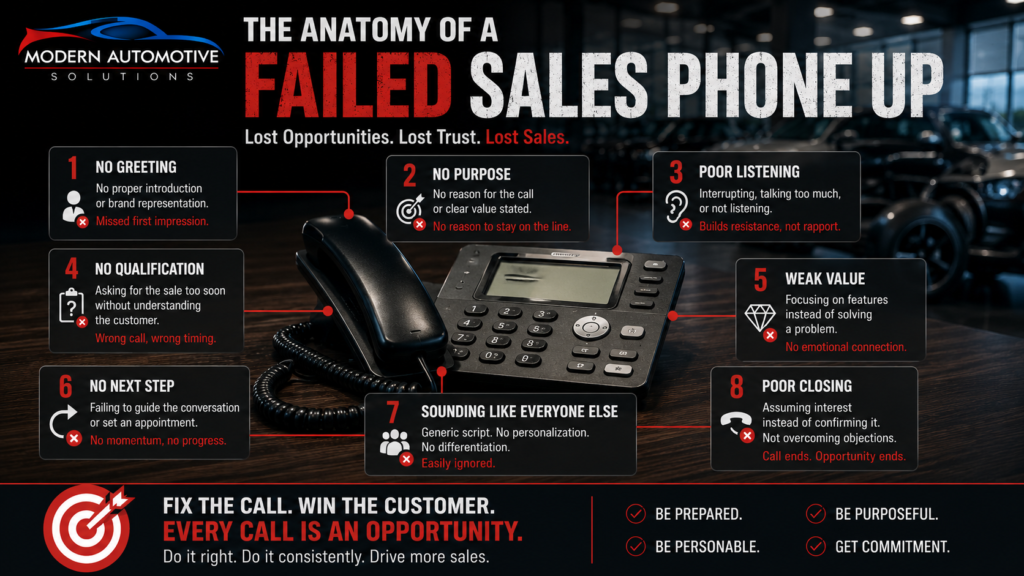
The Scenario: A customer, Mark, submits an internet lead on a specific used 2023 Chevrolet Tahoe. Ten minutes later, rather than waiting for an email response, Mark calls the dealership directly. He is routed to a floor salesperson, David, who is sitting at his desk.
The Interaction
David (Salesperson): “Thanks for calling XYZ Motors, this is David.” Mark (Customer): “Hey David. I just sent an email about the black 2023 Tahoe you have online. Is it still there, and what’s your absolute best out-the-door price on it? I’m cross-shopping a few right now.” David: “Let me check the system. Yep, looks like it’s still here. Our internet pricing is heavily researched, so the $52,000 you see online is our best price, plus your standard tax, title, and dealer fees.” Mark: “Oh, okay. Well, there is a dealer about forty miles away with a similar one for $50,500.” David: “Yeah, but you have to be careful with those other guys. Our cars go through a strict 150-point inspection, so you get what you pay for. When did you want to come down and take a look at it?” Mark: “I’m pretty busy this week. Let me think about it and I’ll call you back.” David: “Okay, just let me know. They sell fast!”
Result: Mark hangs up, David logs a generic note in the CRM (“Wants lower price, will call back”), and the deal dies completely.
The Post-Mortem: Why the Call Failed
David didn’t lose this deal because the car was priced too high. He lost the deal because he treated a dynamic sales opportunity like a transactional drive-thru order.
Here are the three critical failures in this call:
- Failure 1: Answering the Price Question Prematurely David instantly validated the customer’s premise that price is the only thing that matters. By giving an out-the-door quote before building any value or understanding the customer’s true needs, David effectively commoditized his own inventory.
- Failure 2: Defensive Selling When Mark brought up the competitor’s cheaper vehicle, David got defensive (“you have to be careful with those other guys”). Trashing the competition creates friction and instantly raises the buyer’s defensive guard.
- Failure 3: The Weak Call to Action Asking “When did you want to come down?” puts all the mental labor on the customer. It is an open-ended, low-value question that makes it incredibly easy for the buyer to brush off the salesperson with the classic “I’ll think about it” line.
The Correction: The Optimized Call Structure
A high-performing, optimized sales process flips this dynamic entirely. The goal of the phone call is never to sell the car or negotiate the gross; the singular goal of the phone call is to sell the appointment.
| TRADITIONAL CALL | OPTIMIZED CALL |
| Focuses on selling the car Defends the price Trashes the competition Open-ended scheduling | Focuses on selling the appointment Acknowledges price, pivots to value Consults on the buyer’s true needs Offers an either/or appointment time |
How David should have handled it:
- The Pivot: “Mark, that’s a great question, and I completely respect that you’re shopping around to find the best deal. That black Tahoe is actually one of our most popular pieces of inventory right now. Before I put together a comprehensive out-the-door worksheet for you, are you buying this for family road trips, or just daily commuting?” (This lowers the defense mechanism and starts a consultative dialogue).
- The Value Build: “I saw that $50,500 one down the road as well. It’s a solid truck, but the reason we priced ours at $52,000 is because it has the upgraded towing package and brand new Michelin tires, which saves you about $1,200 right off the bat.”
- The Strong Close: “I have the keys on my desk right now. I have a VIP test drive slot open at 2:15 PM, or would 4:30 PM work better for your schedule to come see if it’s even the right truck for you?”
When you review the call recordings at your dealership, are your team members struggling more with defending the price, or with actually locking down a firm appointment time?