“We’ve been running our dealership this way for years, and we’re still profitable. Why should we change our workflows now?”
Profitability is a great benchmark—but it doesn’t necessarily mean you’re operating at peak efficiency.
Today’s automotive retail environment is dramatically different than it was even five years ago. Customers expect a faster, more transparent buying experience. They complete much of their research online, arrive better informed, and expect to spend less time inside the dealership. What was once considered acceptable is now viewed as friction.
The question isn’t whether your dealership is profitable.
The question is: How much additional profit is hidden inside your existing operation?
Every unnecessary handoff, approval delay, duplicate data entry, misplaced key, or disconnected workflow quietly costs your dealership time, money, and customer satisfaction. Those small inefficiencies compound every single day, reducing sales capacity, limiting service throughput, increasing employee frustration, and creating an inconsistent guest experience.
Our goal isn’t to tear apart processes that are working.
It’s to identify the bottlenecks that prevent your team from performing at its highest level.
We evaluate every step of your sales and service operations to remove unnecessary friction, simplify workflows, and create a more efficient customer journey—without disrupting your culture or changing what already makes your dealership successful.
The result is an operation where:
Deals move through the sales process faster.
Service advisors spend more time selling and less time on administrative tasks.
Employees experience less stress and greater productivity.
Customers enjoy a smoother, faster, VIP-level experience.
The dealership captures more revenue from the same traffic while improving margins.
Optimization isn’t about fixing what’s broken.
It’s about eliminating what’s slowing you down so your team can sell more vehicles, write more repair orders, increase profitability, and deliver an exceptional customer experience—all with less friction than ever before.
Here is a professional copy-editing of your text. I’ve polished the flow, enhanced the impact of your key points, and utilized formatting to make the value proposition highly scannable for busy dealership principals.
The Profit Illusion: Why “Good Enough” is Costing Your Dealership
“If it ain’t broke, why fix it?”
It’s a fair question. If your dealership has been running the same way for years and remains profitable, change can feel like an unnecessary risk. Profitability is a fantastic benchmark—but it isn’t proof of peak efficiency.
The automotive retail landscape has shifted dramatically. Today’s buyers complete most of their research online, arrive highly informed, and expect a swift, transparent transaction. The legacy processes that were once considered standard industry practice are now viewed by modern consumers as friction.
The real question isn’t whether your dealership is making money. The question is: How much gross profit is slipping through the cracks of your current operation?
The Hidden Cost of Friction
Every unnecessary handoff, approval delay, duplicate data entry, or disconnected workflow quietly drains your bottom line. These micro-inefficiencies compound daily, resulting in:
-
Choked Sales Capacity: Reps spending time on paperwork instead of customers.
-
Stifled Service Throughput: Advisors bogged down by administrative tasks.
-
Employee Burnout: High turnover driven by frustrating, clunky internal systems.
-
Damaged CSI Scores: Modern guests expect a modern experience; delays break trust.
Our Approach: We aren’t here to tear down your culture or fix what already works. Our goal is to identify and eliminate the quiet bottlenecks that prevent your high-performing team from reaching their absolute ceiling.
The Optimized Dealership
By evaluating and streamlining every step of your sales and service operations, we remove friction without disrupting the core identity that makes your dealership unique.
                                  THE IMPACT
┌───────────────────────────────┬───────────────────────────────┐
│         SALES FLOOR           │         SERVICE DRIVE         │
├───────────────────────────────┼───────────────────────────────┤
│ • Deals move faster           │ • Reduced admin friction      │
│ • Higher volume per rep       │ • Higher RO averages          │
│ • Transparent buyer journey   │ • Increased bay utilization   │
└───────────────────────────────┴───────────────────────────────┘
When you eliminate what slows you down, your operation transforms:
-
Velocity: Deals move from first pencil to F&I with precision speed.
-
Advisor Focus: Service advisors spend their time selling tech recommendations, not chasing down paperwork.
-
Retention: Employees experience less stress, leading to higher productivity and lower turnover.
-
VIP Experience: Customers enjoy a seamless, modern buying journey that earns lifetime loyalty.
-
Margin Expansion: Your dealership captures more revenue from your existing traffic, maximizing the value of every single lead.
Optimization isn’t about fixing a broken business. It’s about unleashing a more profitable one.
Would you like to tailor this copy for a specific channel, such as a LinkedIn article, a direct email campaign to Dealer Principals, or a B2B landing page?
b2b
Here is the text reframed specifically as a B2B email/direct outreach campaign targeting Dealer Principals, General Managers, and Executive Managers.
This version uses sharp, executive-level hook phrasing and clean formatting to respect a busy decision-maker’s limited time.
Subject: Is “good enough” costing your dealership? (Hidden gross profit)
Hi [First Name],
“If it ain’t broke, why fix it?”
It’s a standard perspective in automotive retail. If your stores have been running the same way for years and are still profitable, workflow automation or process change can feel like an unnecessary disruption.
Profitability is a great benchmark—but it isn’t proof of peak efficiency.
The reality is that today’s buyers complete most of their research online, arrive highly informed, and expect a swift, transparent transaction. Legacy workflows that were acceptable five years ago are now viewed by modern consumers as friction points.
The question isn’t whether your dealership is making money. The question is: How much gross profit is slipping through the cracks of your current operation?
The Cost of Micro-Inefficiencies
Every unnecessary handoff, desk approval delay, duplicate data entry, or disconnected tool quietly drains your bottom line. These small friction points compound daily across your rooftop, resulting in:
-
Reduced Sales Velocity: Reps bogged down by admin tasks instead of closing active floor traffic.
-
Stifled Service Throughput: Advisors spending more time navigating legacy software than selling lines on repair orders.
-
Employee Turnover: Top talent leaving due to frustrating, clunky internal systems.
-
Eroded Margins: Higher operational costs per unit sold or repaired.
Our Strategy: We don’t tear down the culture or processes that made you successful. We target and eliminate the invisible bottlenecks that prevent your team from performing at its absolute ceiling.
The Optimized Rooftop
By auditing and streamlining your sales and service operations, we unlock hidden capacity without disrupting your daily business.
-
Accelerated Deal Flow: Move customers from first pencil to F&I with precision speed.
-
High-Value Advisors: Transition your service drive from administrative logging to high-margin revenue generation.
-
Maximized Traffic: Capture more revenue from your existing floor and service traffic—expanding your margins without increasing your ad spend.
Optimization isn’t about fixing a broken business. It’s about eliminating what’s slowing you down so you can capture the profit you’re already earning.
Let’s look at where your operations might be leaking revenue. Do you have 10 minutes for a brief introductory call next Tuesday or Wednesday afternoon?
Best regards,
[Your Name] [Your Title]
[Your Company]
[Contact Information]
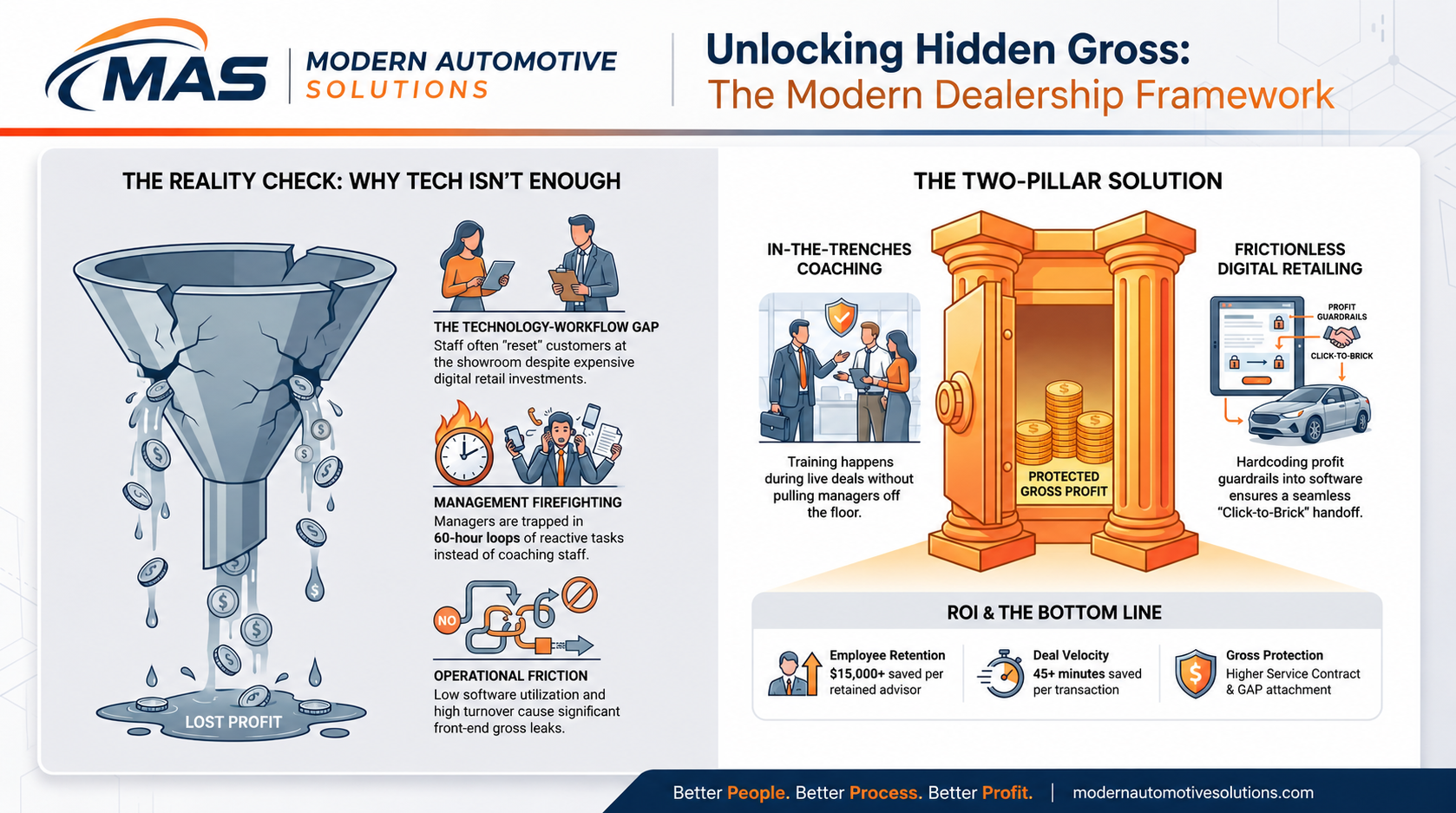
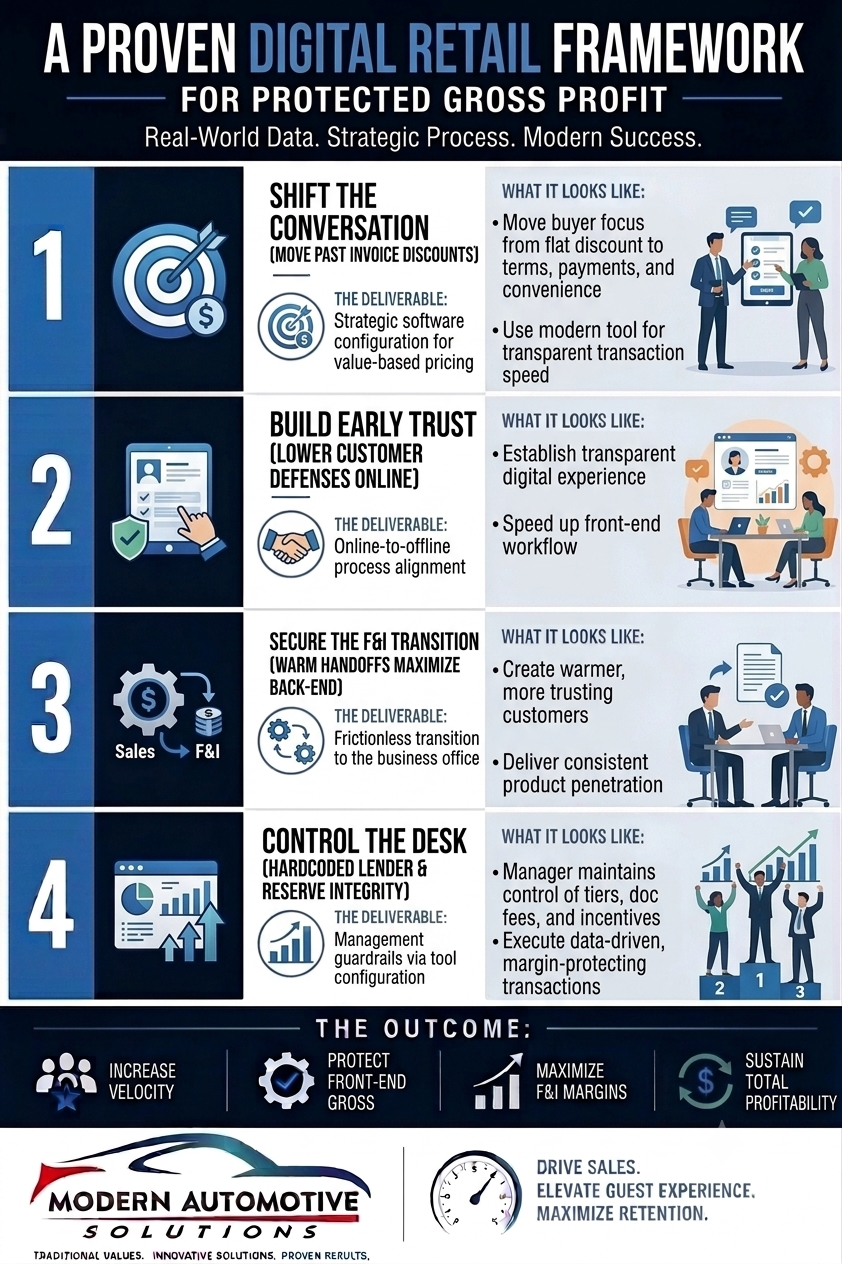
If we let customers build their own deals online, aren’t we just creating a ‘race to the bottom’ and blowing out our front-end gross profit? Actually, the data shows the exact opposite when the process is handled correctly. When a customer negotiates completely from scratch on your showroom floor, their guard is up, and they push for the deepest discount.
When they use digital retail tools, they are focused on payment structure, terms, and convenience rather than just a flat discount on the selling price. Furthermore, by speeding up the front-end process, your team has a warmer, more trusting customer when they transition to F&I, which protects your back-end gross. We don’t use digital retail to cut prices; we use it to sell the speed and transparency of the transaction.
Here is a B2B copy-editing of this objection-handling perspective. This version is designed to instantly disarm a skeptical General Sales Manager (GSM) or Dealer Principal by reframing digital retailing from a “margin killer” to a “gross protector.”
The Digital Retail Myth: Why Transparency Protects Front-End Gross
“If we let customers build their own deals online, aren’t we just creating a ‘race to the bottom’ and blowing out our front-end gross?”
It’s the number one fear dealers have about digital retailing. But the data shows the exact opposite when the process is handled correctly.
Shift the Focus from Price to Payments
When a customer negotiates completely from scratch on your showroom floor, their defensive guard is up. They assume they are going to be taken advantage of, so they push aggressively for a flat discount on the selling price.
Digital retailing tools completely flip this dynamic:
-
The Psychology of Control: When buyers build a deal online, they focus on payment structure, loan terms, and down payments rather than just slashing the MSRP.
-
Value Over Discounts: Customers naturally adjust levers (like term length or cash down) to find a budget they are comfortable with, effectively desensitizing them to the raw purchase price.
Protecting the Back-End
Speeding up the front-end process doesn’t just protect your initial margin—it sets up a massive win for your finance department.
   TRADITIONAL DESKING                 DIGITAL RETAILING
┌─────────────────────────┐       ┌─────────────────────────┐
│ • Hours of grinding     │       │ • Fast, transparent tool │
│ • High customer guard   │  VS   │ • Warmer, relaxed buyer │
│ • Fatigued F&I handover │       │ • High-margin F&I upsell│
└─────────────────────────┘       └─────────────────────────┘
By removing the traditional friction from the desk, your sales team hands over a warmer, more trusting customer to the box. Because the buyer isn’t exhausted or defensive from a three-hour negotiation, they are far more receptive to F&I products like VSCs, GAP, and ancillary coverages.
The Bottom Line: We don’t use digital retail to cut prices; we use it to sell the speed and transparency of the transaction. It isn’t a discounting tool—it’s an efficiency engine that protects your total gross per component.
Would you like to turn this specific objection-handler into a follow-up email for your B2B campaign, or perhaps a LinkedIn thought-leadership post?
can you expand on this
Here is an expanded, deep-dive version of this argument. This content is structured to serve as an authoritative white paper section, a comprehensive blog post, or a high-impact sales presentation deck for dealership executives.
Retaining Gross in a Digital World: The Psychology of the Modern Car Buyer
The hesitation to fully adopt digital retailing (DR) usually stems from a single, deeply ingrained fear: “If I put my numbers online, the customer will just shop them across town, and I’ll have to cut my throat to win the deal.”
It feels intuitive. If you give up control of the desk, you give up control of the margin.
However, modern automotive retail data reveals a paradox: Dealers utilizing structured digital retailing processes consistently maintain equal or higher total gross per code (PVR) than those relying solely on traditional, high-friction showroom floor grinds.
Here is the psychological and operational breakdown of why transparency actually protects your gross profit.
1. The “Showroom Defense Mechansim” vs. The Digital Workspace
When a customer walks into a traditional showroom floor, their defense mechanism is fully engaged. They expect a battle. Because they lack visibility into how the numbers are generated, they fall back on the only defensive weapon they have: demanding a flat discount on the selling price. Digital retailing changes the consumer’s cognitive state from defense to problem-solving.
-
The Psychology of Choice: When a buyer interacts with a digital desking tool, they aren’t fighting a closer; they are configuring variables.
-
The “Levers” Effect: Instead of demanding $2,000 off the MSRP, the buyer actively manipulates the term length (60 vs. 72 months), adjusts their down payment, or alters their trade-in expectations to reach their target monthly payment.
-
Ownership of the Number: Because they moved the sliders to find the payment, they take psychological ownership of the deal structure. They are far less likely to fight a price that they technically built themselves.
2. Shifting the Unit of Value: Price vs. Time
Modern consumers do not value a $500 discount as much as they value two hours of saved time.
In the Amazon era, convenience is a premium commodity. When a dealership provides a transparent online workflow, they are no longer just selling a vehicle—they are selling an efficient transaction.
The Transactional Premium: Customers are highly willing to pay full market value for a vehicle if the buying process is painless, predictable, and fast. When you compete on speed, you no longer have to compete purely on price.
3. Priming the Buyer for High-Margin F&I
The front-end and the back-end of a dealership do not exist in vacuums. The friction created at the sales desk directly dictates the profitability of the finance box.
In a traditional deal, by the time the customer is handed over to F&I, they are exhausted, hyper-vigilant, and suffering from decision fatigue. Their main objective is to sign the paperwork and escape, resulting in a high rejection rate for aftermarket products.
Conversely, a digital retail buyer enters F&I relaxed and ahead of schedule. Because the front-end process was transparent, the trust tax has already been paid. This psychological safety makes them significantly more receptive to the value proposition of:
-
Vehicle Service Contracts (VSCs)
-
GAP Insurance
-
Tire & Wheel Protection
-
Ancillary coverages
By accelerating the front-end, you preserve the customer’s mental stamina, protecting your back-end yield.
Summary: Digital Retailing is a Closing Tool, Not a Discount Tool
Digital retailing was never meant to be a self-service checkout lane that minimizes dealership interaction. It is an advanced qualification and desking tool. When properly integrated into your CRM and showroom culture, it ensures your sales team greets an educated, high-intent buyer who is focused on terms rather than discounts. You aren’t lowering the bridge to invite a race to the bottom—you are building a highway to a faster, more profitable close.